
Nvidia and Siemens Use AI to Design Advanced 3D Chips
Credit: Siemens
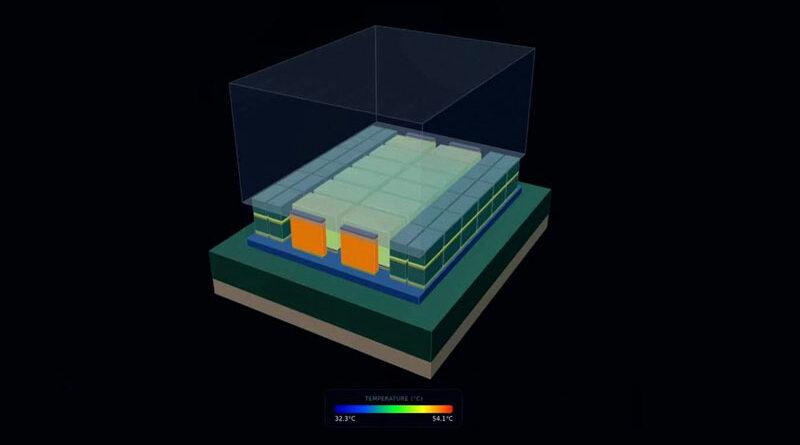
NVIDIA and Siemens are expanding the role of artificial intelligence in semiconductor engineering, bringing AI-powered automation to one of chip design’s most complex challenges: building advanced 3D integrated circuits.
Announced on October 21, 2026, the latest development focuses on using agentic AI to coordinate electrical and thermal analysis across multiple electronic design automation (EDA) tools. The goal is to help engineers explore more design options while identifying power delivery and heat-related problems earlier in development.
AI Tackles the Complexity of 3D Chip Design
Unlike traditional flat chip designs, 3D integrated circuits stack or combine multiple semiconductor dies within a single package. This approach can improve performance and data transfer, but it also creates difficult engineering challenges involving power consumption, heat dissipation and electrical reliability.
Siemens’ Fuse EDA AI Agent is designed to coordinate analysis across seven EDA tools, automating a workflow that spans nine stages. Using NVIDIA’s accelerated computing technology and AI capabilities, the system can evaluate alternative configurations and help engineers identify potential bottlenecks.
According to Siemens, the approach can reduce engineering effort by up to 95% and enable teams to evaluate up to 50 times as many design alternatives compared with conventional manual workflows. These figures are company-reported results, not guarantees for every project.
Why This Matters for AI Hardware
As AI models grow larger, semiconductor companies face increasing pressure to deliver more computing power within limited space and energy budgets. Advanced 3D packaging offers a way to bring computing and memory closer together, but managing heat and power becomes increasingly important.
Automating parts of the analysis process could help engineers test more configurations in less time, potentially shortening development cycles and improving design reliability.
The technology does not eliminate the need for human expertise. Engineers must still define design goals, evaluate trade-offs and validate results against rigorous manufacturing requirements.
A Step Toward AI-Driven Chip Engineering
The announcement builds on the broader NVIDIA–Siemens partnership, which aims to integrate AI and GPU acceleration throughout semiconductor design, verification and manufacturing workflows.
If these tools prove effective across a wider range of real-world projects, agentic AI could become an important part of designing next-generation chips for data centers, AI accelerators and high-performance computing systems.
For now, the key development is not AI independently inventing an entire processor. It is AI coordinating complex engineering tasks and exploring more possible designs, giving chip designers a faster way to address the growing challenges of 3D integration.


