
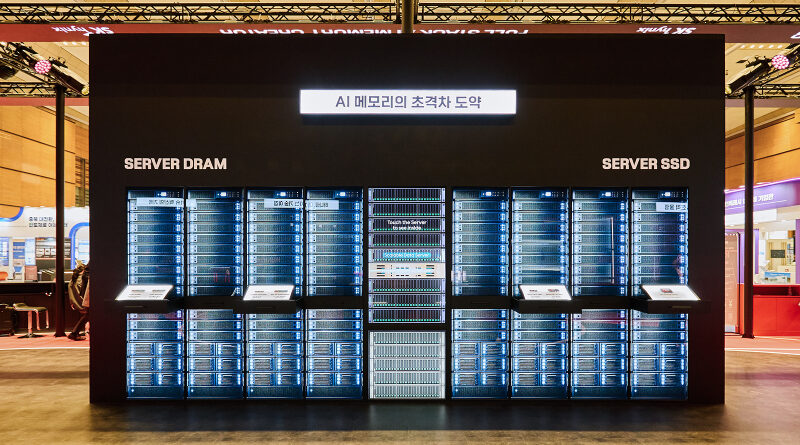
SK Hynix Devised Energy-Efficient and Compact H-TPU Cores for the Ultra-Fast SSDs
Credit: SK Hynix
SK hynix has developed a new processor architecture designed to make next-generation solid-state drives (SSDs) more energy-efficient while reducing the space required inside storage controllers. The technology, called Hynix Transaction Processing Unit (H-TPU), uses more than 100 compact, specialized processor cores to handle routine storage operations.
The company detailed the architecture at the International SoC Design Conference (ISOCC 2026) in South Korea, highlighting a potential solution to one of the growing challenges in high-performance storage: increasing processing demands without a corresponding rise in power consumption.
Smaller Cores Designed for Faster SSDs
Traditional SSD controllers rely on general-purpose CPU cores to manage read and write commands, metadata, and buffer operations. As drive speeds increase, these tasks become more demanding, often requiring additional processing resources.
SK hynix designed H-TPU cores specifically for these repetitive workloads. Rather than assigning every operation to a powerful general-purpose processor, the new architecture distributes tasks across multiple lightweight processing units.
According to the company’s presentation, each H-TPU consumes approximately 2.5% of the power and occupies around 4% of the chip area of a conventional general-purpose CPU core. The simplified four-stage pipeline is designed to handle routine operations efficiently, while the main CPU remains responsible for more complex functions, including error recovery and exception handling.
Power Efficiency Becomes a Priority
Energy efficiency is becoming increasingly important as enterprise SSDs support AI infrastructure, cloud computing, and data-intensive applications. Lower controller power consumption could help reduce overall energy requirements, particularly in large data centers operating thousands of drives.
The H-TPU architecture also activates only the processing units required for a particular operation, allowing unused cores to remain idle. This approach is intended to avoid wasting energy on unnecessary processing activity.
However, real-world performance and power savings will depend on implementation, workload, and the design of the final storage products.
Future Applications in AI Storage
SK hynix plans to apply H-TPU technology to next-generation enterprise SSD controllers and other NAND-based storage products. The company also sees potential applications in High Bandwidth Flash (HBF), an emerging technology intended to address the growing data demands of AI systems.
By combining specialized processing with more efficient storage hardware, SK hynix aims to improve how data moves between flash memory and computing systems.
Although H-TPU is not itself an AI accelerator, its ability to manage storage transactions efficiently could help reduce controller overhead as AI workloads continue to expand.
A New Direction for SSD Controller Design
SK hynix’s H-TPU architecture represents a shift toward smaller, task-specific processors instead of relying exclusively on increasingly powerful general-purpose CPU cores.
The technology’s ultimate impact will depend on its integration into commercial products and independent performance testing. If the design delivers its expected efficiency gains, it could become an important component of future high-speed enterprise SSDs and AI-focused storage systems.


