
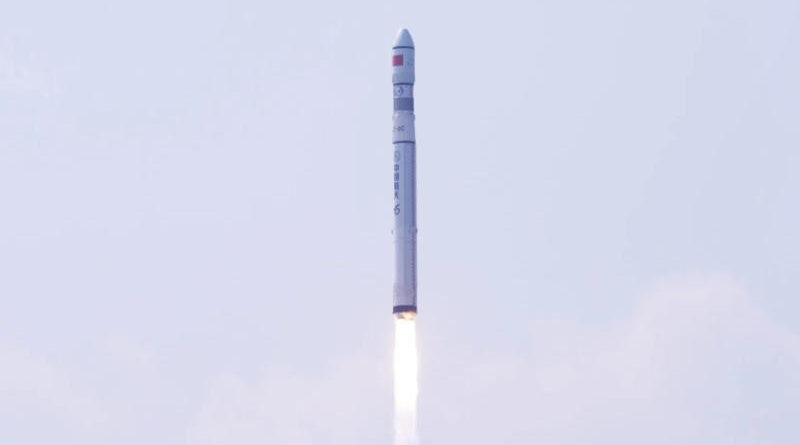
A Chinese Rocket Throw A Pile Of Debris Into Orbit
Credit: China Aerospace Science and Technology Corporation
The upper stage of China’s Long March 6C launch vehicle disintegrated in low Earth orbit less than two days after the successful launch of seven satellites. According to LeoLabs, the incident generated dozens, and possibly hundreds, of new space debris.
China’s Long March 6C rocket launched this week and successfully placed seven satellites into orbit, but its upper stage disintegrated in low-Earth orbit, according to data from California-based LeoLabs. The debris was first detected on August 26 by LeoLabs’ radar facility in Western Australia.
LeoLabs has not yet completed its analysis or released a final conclusion, but the company noted: “Based on similar fragmentation events, it is possible that the debris generated by this event could pose a collision hazard to any spacecraft operating at altitudes up to 1,000 km.” The Chinese rocket body is at an altitude of 396 to 482 km; according to images published by LeoLabs, the debris is at an altitude of 500 to 520 km. This could pose a problem for low-orbit satellite constellations, including Starlink, which currently has approximately 11,000 satellites in orbit. This year, SpaceX began moving more than 4,000 Starlink satellites to orbits at an altitude of 480 km; there are currently more than 8,500 satellites in orbits between 460 and 490 km.
“This is the third time a stage of China’s Long March 6 launch vehicle has broken up in low Earth orbit in the past four years. The first occurred on November 12, 2022, and the second on August 6, 2024,” LeoLabs writes.
The relatively low orbital altitude plays into the rocket’s favor: the drag of the upper atmosphere will gradually lower the orbits of the debris, and most of it is expected to burn up upon reentry within a few years. The cause of the upper stage’s breakup has not yet been determined.


