NASA’s Voyager 1 Reaches One Light-Day From Earth After 49 Years
Credit: NASA
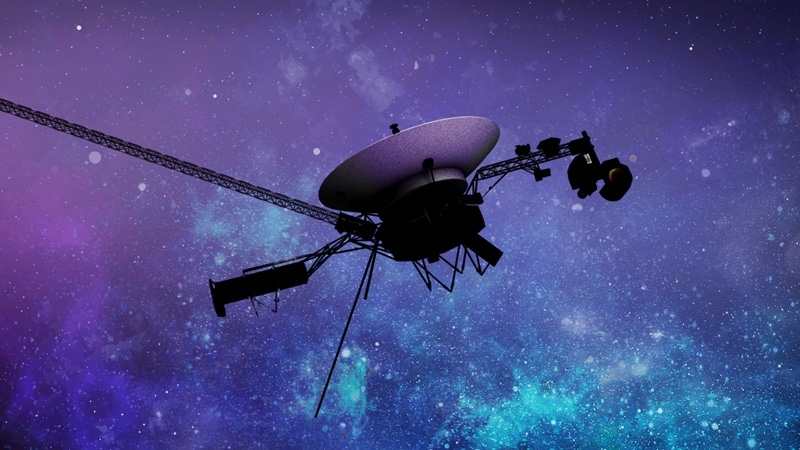
NASA’s Voyager 1 spacecraft has reached a remarkable milestone, becoming the first human-made object to travel one light-day away from Earth. Launched in September 1977, the legendary space probe has spent more than 49 years traveling through space and continues to send scientific data back to our planet.
According to NASA, Voyager 1 reached the milestone on November 18, covering approximately 16.09 billion miles (25.9 billion kilometers). A light-day represents the distance light travels in 24 hours, rather than a measurement of time.
Communication now takes an entire day
The achievement has an interesting consequence for NASA engineers. Radio signals travel at the speed of light, meaning commands sent from Earth now take approximately 24 hours to reach Voyager 1. Receiving a response requires another full day.
In practical terms, communicating with the spacecraft has become a two-day process, even though signals travel at the fastest speed possible.
Voyager 1 is currently moving at approximately 38,000 mph (61,000 km/h) and is exploring interstellar space, having crossed the heliosphere — the protective bubble created by the Sun — in August 2012.
A spacecraft that refuses to retire
Despite being designed for a much shorter mission, Voyager 1 remains operational nearly five decades after launch. Its power supply, based on a plutonium-238 radioisotope thermoelectric generator, gradually loses capacity, forcing engineers to shut down equipment and scientific instruments to conserve energy.
NASA continues to receive measurements from the spacecraft, including information about magnetic fields, cosmic rays and plasma waves in interstellar space.
Recent engineering efforts have focused on extending the mission by replacing power-hungry systems with more efficient alternatives.
The journey is far from over
Voyager 1 was originally launched to study Jupiter and Saturn, delivering historic observations that transformed our understanding of the outer Solar System. Today, it continues traveling into the space between stars, carrying the famous Golden Record — a collection of sounds, images and greetings representing life on Earth.
Reaching one light-day is more than just another distance record. It demonstrates how far human engineering can go and how scientific missions can continue producing valuable discoveries long after their original objectives have been completed.
And while Voyager 1 is now farther from Earth than any other human-made object, its journey into interstellar space is still continuing.