
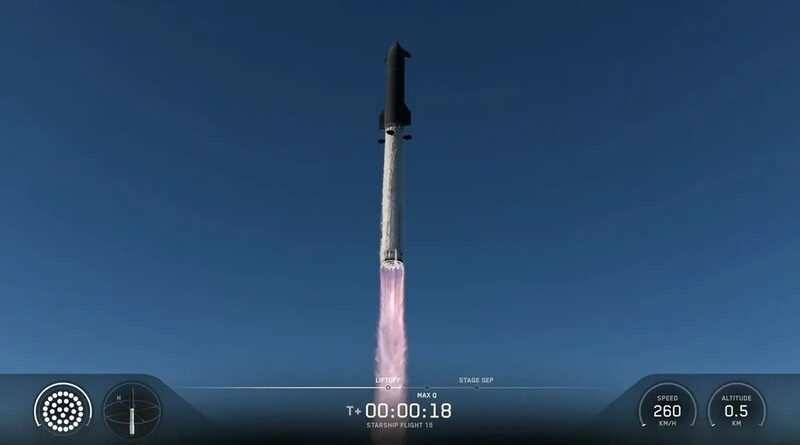
SpaceX Starship Flight 15: Super Heavy Booster Catch Fails
Credit: SpaceX
SpaceX has completed another major Starship test flight, but one of its most ambitious objectives remains out of reach. The Super Heavy booster failed to return to the launch tower for a planned mid-air catch, highlighting the technical challenges behind the company’s fully reusable rocket ambitions.
SpaceX launched its Starship rocket on its 15th test flight on November 13, 2026, from Starbase in South Texas. The mission was designed to demonstrate a major step toward full rocket reusability: recovering both the Super Heavy booster and the Starship upper stage using the launch tower’s giant mechanical arms, commonly known as “chopsticks.”
However, the first part of the plan did not go as expected.
Super Heavy booster recovery attempt called off
Following a successful liftoff and stage separation, the Super Heavy booster began its return sequence toward the launch site. SpaceX had planned to catch the massive first stage directly at the launch tower, repeating a recovery technique demonstrated during previous test flights.
But a technical issue forced flight controllers to abort the planned catch.
Instead of returning to Starbase, the booster was diverted toward the Gulf of Mexico, where it made an offshore descent. The exact cause of the problem has not yet been publicly established.
The decision highlights how SpaceX prioritizes flight safety over achieving a recovery milestone during experimental missions.
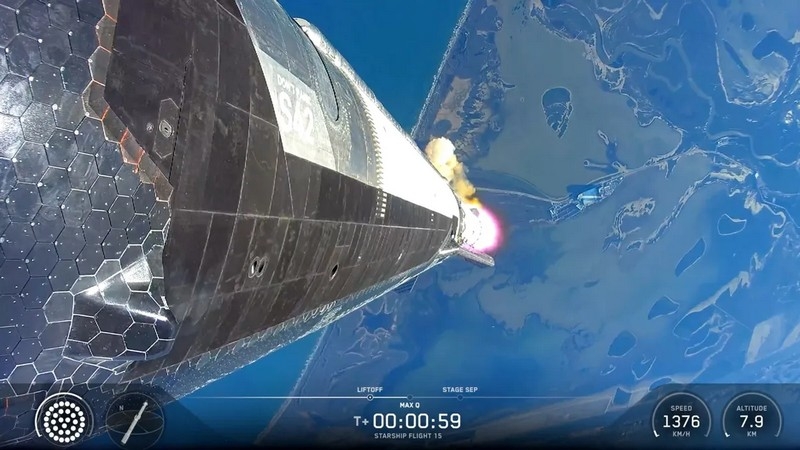
Starship continues its mission
Despite the unsuccessful booster recovery, the upper stage continued its flight.
Starship was expected to spend approximately 22 hours in space, completing around 14 orbits of Earth before attempting its return to Starbase.
The spacecraft also carried 26 next-generation Starlink V3 satellites, adding another important objective to the test flight.
SpaceX still has an opportunity to achieve a historic milestone if the upper stage successfully returns and is caught by the launch tower. Such a recovery would mark the first successful catch of a Starship spacecraft.
Why the failed catch matters for SpaceX
Full reusability is one of the most important goals behind the Starship programme. Unlike conventional rockets, which often discard major components after launch, SpaceX wants both stages of Starship to return to Earth and fly again.
The ability to catch and rapidly reuse the Super Heavy booster could significantly reduce launch costs, shorten turnaround times and make frequent missions to orbit more practical.
The technology is also central to SpaceX’s long-term ambitions, including the expansion of the Starlink satellite network and future missions to the Moon and Mars.
Starship has been selected as part of NASA’s Artemis programme, which aims to return astronauts to the lunar surface.
Although the failed booster catch is a setback, Flight 15 remains an important test for the next generation of SpaceX’s launch system.
For SpaceX, the challenge is no longer simply getting the world’s largest rocket into space. It is proving that the entire vehicle can return, be recovered and fly again.


