
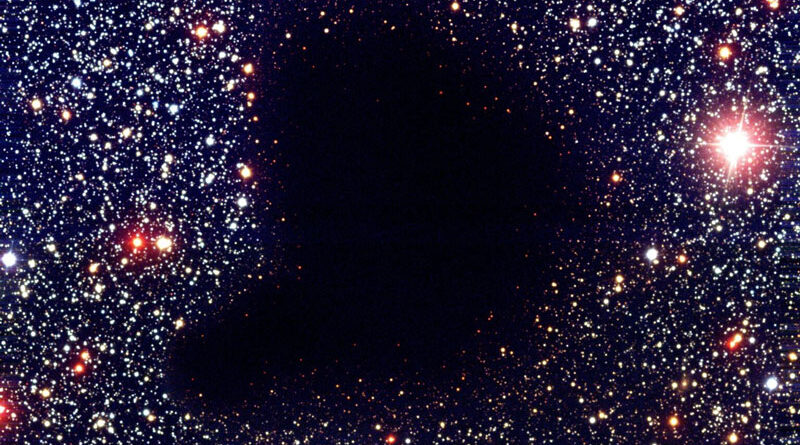
Mysterious Signal Came From an Empty Region of Space
Credit: ESO
In a well-studied region of space, astronomers have encountered an unexpected mystery. The James Webb Telescope has twice detected bright radiation that was not present during previous observations.
The signal was detected by a team of astronomers led by a scientist from the University of Minnesota. They utilized the James Webb Space Telescope’s coronagraphic capabilities—specifically, a technique involving multi-object coronagraphy for slitless spectroscopy—to search for signals in regions of space devoid of visible objects. This required blocking out light from all nearby sources within the field of observation. While spectra are typically obtained from visible objects, the researchers pursued the opposite approach, searching for spectral signatures originating from faint sources that otherwise remain completely hidden.
In an empty region of space, in the direction of the southern constellation Fornax, astronomers have detected a mysterious emission line with a wavelength of approximately 1.60 microns. The signal was captured during all four observation sessions, and its validity is beyond doubt. This particular area was not chosen by chance: it had previously been the subject of a deep-field survey by the Hubble Space Telescope, and was also observed by the James Webb Space Telescope. Consequently, there is a wealth of data available, which allowed researchers to filter out interference and state with confidence that something exists there in the universe—even though the object remains invisible under all other circumstances.
Moreover, a signal from the object should have been present in the images captured by Webb in 2022, yet it was not there. The supernova hypothesis does not fit, as that would have resulted in a greater number of spectral lines. For the same reason, the possibility of distant galaxies can also be ruled out; Webb would almost certainly have detected their spectral lines previously. Furthermore, galaxies would emit light containing a multitude of spectral lines—something not observed in this case. Another potential explanation is a tidal disruption event, in which a star is torn apart by a wandering black hole, though this remains uncertain.
The study’s authors describe the object as “very unusual,” noting that only new, more sensitive observations will help uncover its true nature. More in-depth spectroscopy could reveal additional emission lines, determine the distance to the source, and ultimately explain exactly what the James Webb Space Telescope observed in a seemingly empty region of space.


