
Anthropic Moves Claude to AMD GPUs in Just Three Days, Challenging Nvidia CUDA
Credit: Anthropic
Anthropic may have found a way to reduce one of the biggest barriers keeping AI companies dependent on Nvidia hardware. According to the company’s investor presentation, its AI model Mythos helped bring Claude to AMD GPUs in just three days, with almost no human intervention.
The announcement could have significant implications for the AI hardware industry, particularly for Nvidia and its CUDA software ecosystem, which has long been one of the company’s strongest competitive advantages.
AI did most of the engineering work
Anthropic co-founder and Chief Compute Officer Tom Brown explained that introducing a new chip platform traditionally required dozens of engineers and several months of development.
This time, however, the company used Mythos to handle almost the entire process. According to Brown, the AI system ported or wrote nearly 100% of the required software kernels, allowing Claude to run on AMD hardware in approximately three days.
The reported achievement involved AMD’s Instinct MI355X GPUs and focused on prompt processing for one of Anthropic’s models.
Why this is a challenge for Nvidia CUDA
Nvidia’s dominance in AI computing is not based on hardware alone. Its CUDA platform provides developers with the software tools needed to build and optimize applications for Nvidia GPUs.
For years, this ecosystem has made switching to competing hardware expensive and technically challenging. Moving existing AI workloads to AMD or other chip manufacturers often required months of engineering work.
Anthropic’s reported breakthrough suggests that advanced AI coding systems could dramatically reduce these migration costs.
If similar results can be achieved by other AI companies, Nvidia may face increasing competition from alternative hardware providers.
Anthropic is building a multi-chip future
The company has also made clear that it does not intend to rely on a single hardware manufacturer.
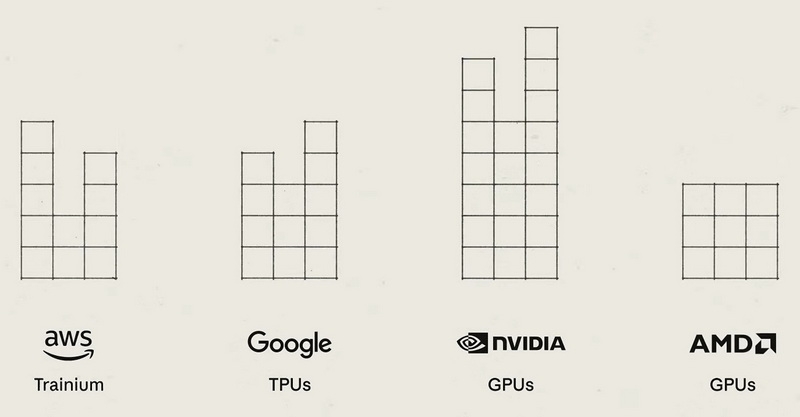
Anthropic’s computing infrastructure spans four major platforms: Nvidia GPUs, AMD GPUs, Amazon’s Trainium chips and Google’s Tensor Processing Units (TPUs).
This strategy gives the company more flexibility when selecting hardware based on availability, performance and operating costs.
However, the three-day result should not be interpreted as proof that Anthropic has completely replaced Nvidia. The reported test covers a specific workload, and the company has not independently demonstrated that all Claude training and inference operations can be migrated with the same speed or efficiency.
What happens next?
Anthropic’s announcement highlights a potentially important shift in the AI industry: artificial intelligence is increasingly being used not only to develop applications, but also to solve the engineering challenges involved in building the infrastructure that powers AI itself.
For Nvidia, this could become a serious long-term challenge. CUDA remains a powerful ecosystem, but if AI models can make software migration significantly easier, hardware customers may gain more freedom to choose between competing chip manufacturers.
The bigger question is no longer simply which company makes the fastest AI chips, but how difficult it will be to switch between them.


