
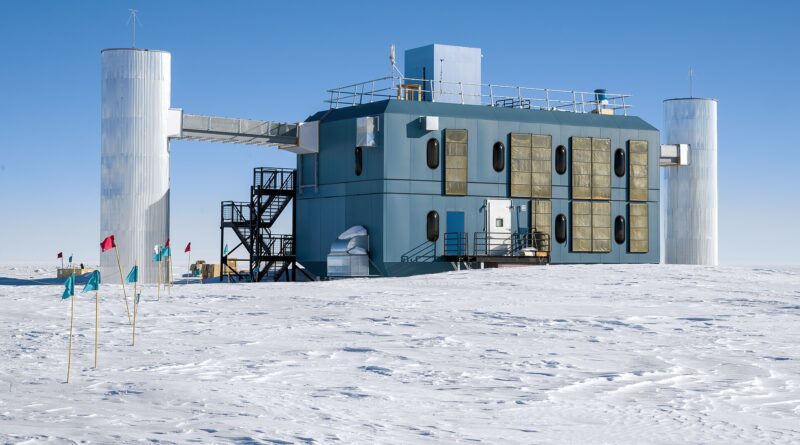
The Nobel Prize In Physics Awarded For The Development Of The IceCube Neutrino Detector
Credit: Wikipedia
Francis Halzen, an 82-year-old Belgian astrophysicist and professor at the University of Wisconsin–Madison (USA), has been awarded the 2026 Nobel Prize in Physics for the creation of the IceCube neutrino observatory and the discovery of high-energy neutrinos of astrophysical origin.
The scientist received the award for “laying the foundation for a completely new field of astronomy.” His concept involves using the ice at the South Pole to capture particles known as neutrinos. The result is the IceCube neutrino observatory, which can track neutrinos originating from deep space.
In essence, IceCube is a cubic kilometer of ice equipped with light sensors. It has enabled researchers to detect neutrinos generated by high-energy processes in the distant universe.
The IceCube observatory was built at the Amundsen-Scott South Pole Station in Antarctica. It employs 5,160 optical sensors embedded in a cubic kilometer of ice to detect neutrinos. As neutrinos pass through the ice, some interact with it, producing particles that emit a characteristic flash of light. The nature and timing of this light make it possible to determine the direction from which the neutrinos arrived, helping scientists trace their cosmic origins. However, these interactions are so rare that the observatory required a vast expanse of pure ice to create the conditions necessary for their detection.


