NASA Launches Hubble’s Successor – The Roman Telescope
Credit: NASA
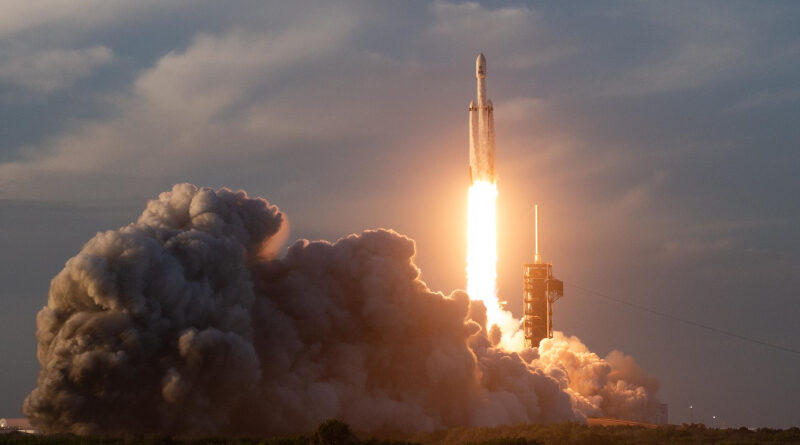
NASA launched the Nancy Grace Roman Space Telescope into orbit. The $4.3 billion telescope lifted off from the Kennedy Space Center in Florida aboard a SpaceX rocket.
The telescope launched into space on August 30 at 7:26 a.m. ET aboard a SpaceX Falcon Heavy rocket from launch pad 39A at Kennedy Space Center in Florida. Thirty-two minutes later, the spacecraft separated from the second stage and continued its flight independently. Specialists established contact with the spacecraft and confirmed the successful deployment of its solar panels and the lower portion of the sunshield. Both Falcon Heavy outer stages returned to their landing pads; the core stage was not rescued.
Roman is often called Hubble’s wide-field cousin. The primary mirrors of both observatories are 2.4 meters in diameter, and their image resolution will be comparable. However, the 300-megapixel infrared Wide Field Instrument (WFI) camera will cover at least 100 times more sky in a single scan. Each Roman image will contain approximately as much information as a hundred Hubble images. In its first five years, the new observatory is expected to survey more than 50 times the sky that Hubble did in three decades.
The telescope is currently heading to the second Lagrange point (L2) of the Sun-Earth system. This is a gravitationally stable region 1.5 million kilometers from Earth in the direction opposite to the Sun. The James Webb Space Telescope (JWST) and Euclid space observatories are already operating there.