BepiColombo Enters Orbit Around Mercury After Eight-Year Journey
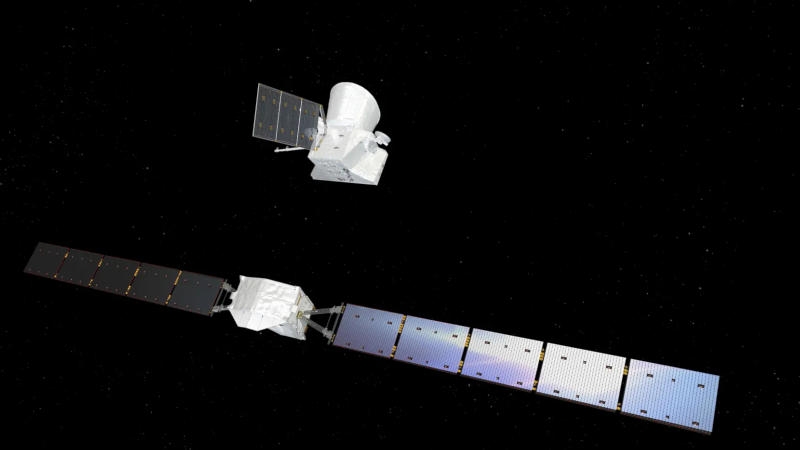
Credit: ESA
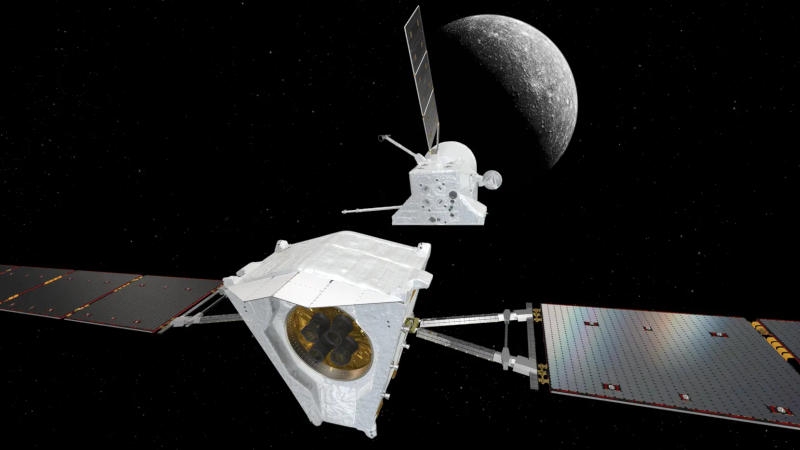
The European-Japanese BepiColombo mission has successfully entered orbit around Mercury after an eight-year journey through the Solar System, opening a new chapter in the exploration of the least-studied rocky planet.
The spacecraft reached its destination on November 21, 2026, marking a major milestone for the joint mission led by the European Space Agency (ESA) and the Japan Aerospace Exploration Agency (JAXA).
Launched in October 2018, BepiColombo travelled more than six billion miles, using multiple gravity-assisted flybys of Earth, Venus and Mercury to reach its final destination.
Two spacecraft, one scientific mission
BepiColombo is designed to deploy two complementary orbiters. ESA’s Mercury Planetary Orbiter (MPO) will investigate the planet’s surface and internal structure, while JAXA’s Mercury Magnetospheric Orbiter, also known as Mio, will focus on Mercury’s magnetic field and surrounding space environment.
This will be the first mission to operate two spacecraft in orbit around Mercury simultaneously.
The initial orbital capture is only the beginning. The two orbiters are scheduled to separate in December 2026, followed by a series of complex manoeuvres to reach their final scientific orbits.
Why Mercury matters
Despite being the closest planet to the Sun, Mercury remains one of the least explored worlds in our Solar System.
Scientists hope BepiColombo will help answer several longstanding questions: Why does Mercury have a magnetic field? What lies beneath its heavily cratered surface? And how can water ice survive inside permanently shadowed polar craters?
The mission will also investigate the planet’s unusually large iron core and its geological history, providing new clues about how rocky planets formed.
When will the science begin?
Following orbital insertion and spacecraft separation, both orbiters will undergo additional manoeuvres and instrument commissioning.
The mission’s main scientific operations are expected to begin in April 2027.
With BepiColombo now at Mercury, scientists are preparing for a new wave of observations that could significantly expand our understanding of the innermost planet — and the early history of the Solar System.