Hidden Planet Beyond Neptune? Scientists Find New Evidence for Planet X2
Credit: pixabay
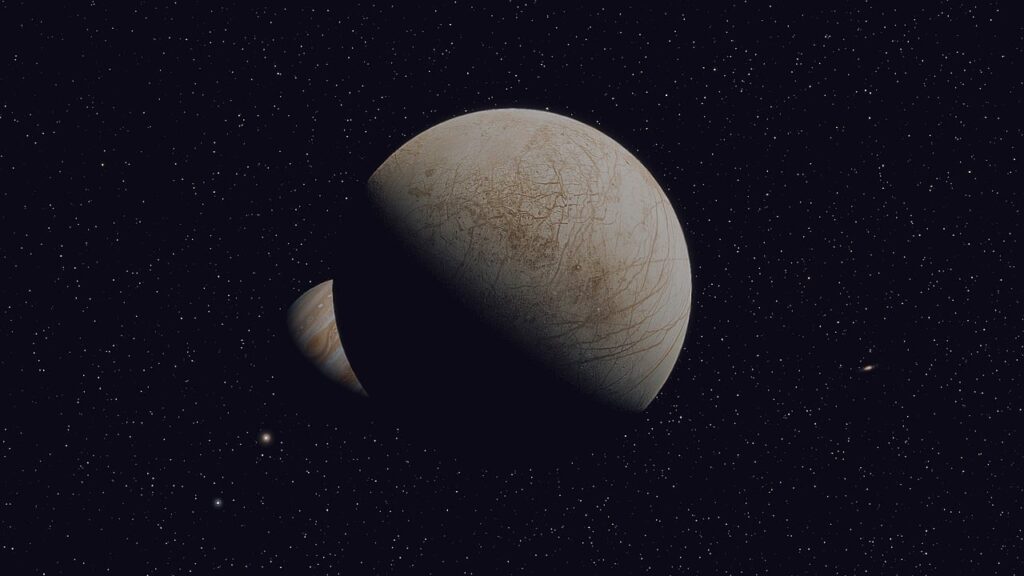
Something unusual is happening in the distant outskirts of our Solar System, and astronomers believe an undiscovered planet could be responsible. New research suggests that the strange orbits of icy objects beyond Neptune may be evidence of a hidden world that has remained undetected for billions of years.
The hypothetical planet, named Planet X2, could have a mass roughly 1.5 to 2 times that of Earth. If it exists, it would be located hundreds of times farther from the Sun than our planet.
Unusual orbits reveal possible clues
The evidence comes from the movement of distant icy objects known as trans-Neptunian objects (TNOs). These bodies occupy the region beyond Neptune and include some of the most mysterious objects in the Solar System, such as Sedna.
Some of these objects follow unusually elongated or highly inclined orbits that are difficult to explain using the gravitational influence of the eight known planets alone.
To investigate the mystery, an international research team conducted computer simulations covering approximately 4.5 billion years of Solar System evolution.
The results were intriguing. Models that included an additional distant planet were much better at reproducing several unusual orbital patterns observed in the outer Solar System.
What could Planet X2 look like?
According to the researchers’ preferred model, Planet X2 could have a mass of approximately twice that of Earth and an orbital distance with a semi-major axis of around 350 to 500 astronomical units.
Its closest approach to the Sun could still be approximately 200 astronomical units. For comparison, Neptune orbits at an average distance of about 30 astronomical units.
The proposed object is different from the better-known Planet Nine hypothesis, which suggests a more massive hidden planet responsible for another set of orbital anomalies.
Interestingly, scientists have not ruled out the possibility that both hypothetical planets could exist.
The search for a hidden world continues
Despite the promising results, Planet X2 has not been directly observed. Its existence remains a scientific hypothesis supported by computer modelling rather than an actual telescope detection.
The next major opportunity to investigate the theory could come from the Vera C. Rubin Observatory in Chile. Its ongoing survey of the night sky is expected to identify large numbers of distant Solar System objects, giving astronomers more data to test the predictions.
If the predicted orbital patterns appear consistently in future observations, the case for another planet beyond Neptune could become significantly stronger.
For now, the distant Solar System remains full of unanswered questions. But the possibility that another Earth-mass world is hiding beyond the known planets makes the search even more fascinating.