
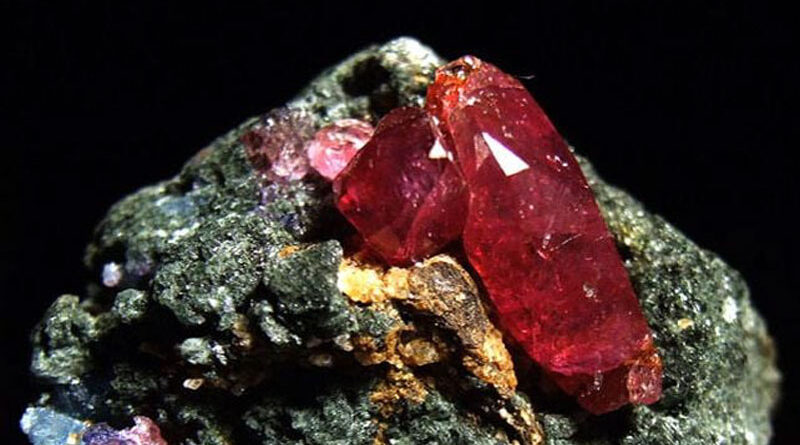
Corundum Discovered On Mars For The First Time
Credit: Wikimedia
NASA’s Perseverance rover has discovered corundum—a crystalline aluminum oxide (Al2O3)—on Mars for the first time, the varieties of which form rubies and sapphires on Earth.
The unexpected discovery was made while studying three rock samples on the rim of Jezero Crater. Corundum had previously not been detected on Mars, either from orbit, directly on the surface, or in Martian meteorites. The conditions necessary for its formation on Mars are virtually nonexistent.
At first, scientists didn’t attach much significance to these fragments, but soon realized they had discovered a “true treasure.”
Corundum is a durable, extremely hard mineral, and its varieties, rubies and sapphires, are highly prized in the jewelry industry. These “tiny grains” also contained a slight hint of chromium, which gives rubies their characteristic reddish-pink hue. This discovery is also valuable because the conditions under which the mineral typically forms are difficult to explain on Mars.
The researchers published their full study in the journal Geophysical Research Letters. There, they described the striking similarities between the Martian and terrestrial versions of the gemstones.
“Its formation typically requires bulk compositions rich in aluminum and depleted in silicon, and it typically forms either at high temperatures or due to tectonic processes. Therefore, its detection in Martian rocks is surprising,” the study’s authors write.
The problem, they say, is chemical, as there is no shortage of heat on Mars. Corundum typically requires a high aluminum content and a low silicon content to form, because if silicate minerals are present, they will absorb all the aluminum and form aluminosilicate rocks such as plagioclase feldspar. All three corundums discovered on Mars were found in plagioclase-dominated rock samples. The scientists say the conditions for their coexistence on Mars are quite difficult to create.
Researchers are considering several mechanisms for the formation of corundum: crystallization from magma, the influence of hot hydrothermal solutions, and, more generally, geological processes. However, they consider the most likely to be an impact origin associated with the formation of the Jezero crater itself. A powerful asteroid impact can briefly create extreme temperatures and pressures and trigger the necessary crystallization reactions. Impact corundum has previously been found in terrestrial impact structures and lunar rocks.


