Ariane 6 Rocket Launched For The First Time With Powerful P160C Solid-Fuel Boosters
Credit: ESA
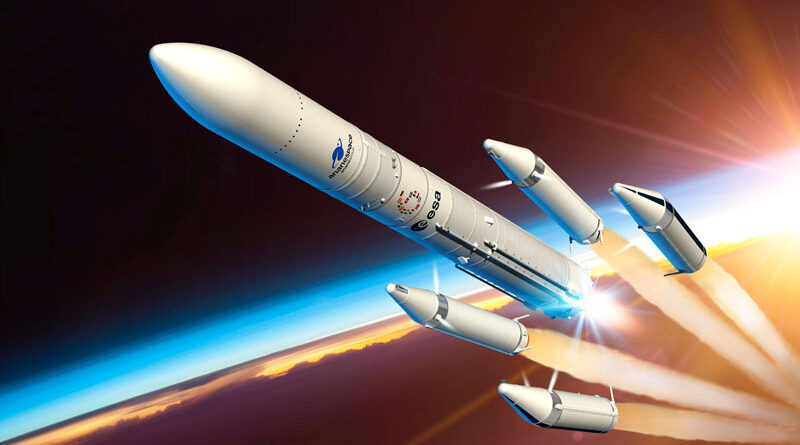
The launch of 36 Amazon Leo satellites from Europe’s spaceport in Kourou, French Guiana, took place on Wednesday, June 17 aboard an Ariane 64 rocket. This launch was the first to use four new, more powerful P160C solid rocket boosters. The satellites were placed into low Earth orbit at an altitude of approximately 465 kilometers less than two hours after launch.
Previously, the rocket launched two packages of 32 Amazon satellites into space in two missions. The increased payload capacity was made possible by the new P160C solid-fuel boosters, each of which holds 14 tons more propellant than the P120C boosters with which the rocket was equipped until now. Today’s launch marked the first time the Ariane 6 launch vehicle used the new boosters in its most powerful configuration.
Under the contract, Arianespace is to perform a series of 18 launches for Amazon. Following the current mission, the number of Amazon Leo satellites launched by Ariane 6 over five months should reach 100. This rocket is now the sole workhorse for Amazon Leo, as all other contracts have been unable to be fulfilled for various reasons.
After launch, teams in the mission control center monitored telemetry, booster separation, payload fairing ejection, core stage operation, and the ignition of the oxygen-hydrogen upper stage with the Vinci engine. According to the plan, the satellites are scheduled to begin separating approximately an hour and a half after launch, and the entire operation, up to the separation of the last satellite, will take approximately 1 hour and 51 minutes.
The P160C was developed jointly by ArianeGroup and Avio. It is also intended to replace the P120C as the first stage of the Vega-C launch vehicle. The maiden flight of the smaller European launch vehicle carrying the P160C is scheduled for 2028.