
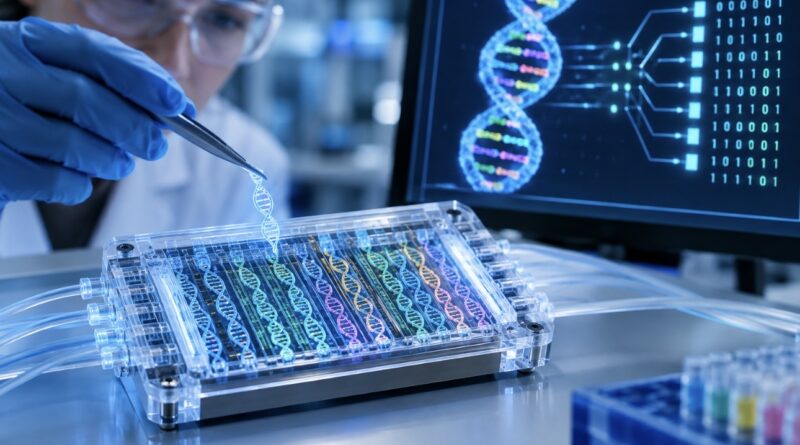
World’s First DNA Computer Created
Credit: AI
Scientists at Maynooth University in Ireland have created one of the most interesting DNA-based molecular computers to date. The system is capable of performing mathematical operations—addition, multiplication, and division—by utilizing the natural mechanisms of DNA strand replication. A novel aspect of this approach is that the computations proceed autonomously, much like quantum annealing: once initiated, one simply waits for the result.
A DNA-based molecular computer consists of a set of interacting DNA strands suspended in water. It requires no electricity to perform calculations—only a small amount of heat is needed. Consequently, in the long run, this technology could potentially displace silicon-based computers from their dominant position; however, it is already indispensable as a diagnostic sensor capable of functioning directly inside a cell.
“Silicon computers consume vast amounts of energy—23% of Ireland’s electricity goes toward computing and data storage. We were limited by the notion that there is only one type of computer, yet there are other examples around us, including our own brains,” says Professor Damien Woods, who led the research.
Physically, such a computer bears no resemblance to what we typically associate with the term; it is simply a test tube containing a solution of salt and DNA.
“A tiny droplet of liquid holds billions, or sometimes even trillions, of DNA strands. These strands interact with one another to produce a result,” explains computer scientist Abir Eshra, who conducted the majority of the experiments.
Researchers believe that DNA computers could eventually fill a niche inaccessible to traditional electronics: ultra-high-density data storage, biocompatible computing devices, and molecular systems capable of operating within an organism. Unlike silicon chips, DNA serves simultaneously as an information carrier and a building material for the computing mechanism. However, the practical application of such systems is currently limited to laboratory settings, as challenges regarding speed, scalability, and the reliable control of complex molecular reactions remain.


