
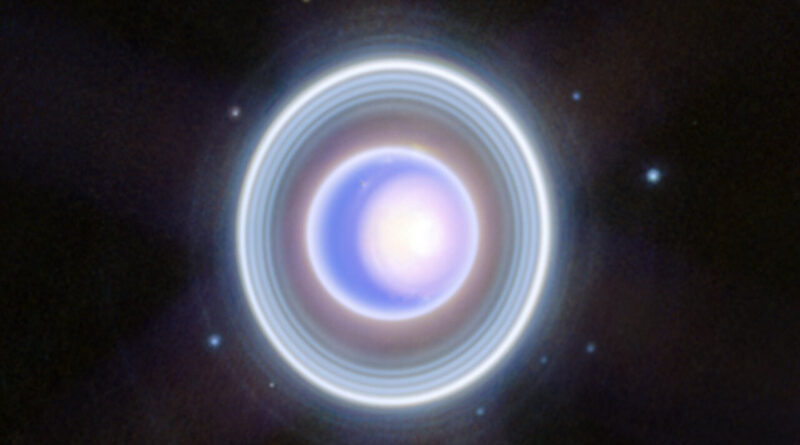
Uranus’ Two Outer Rings Have Completely Different Origins: New Telescope Data
Credit: NASA/ESA
NASA’s James Webb Space Telescope has for the first time imaged the full reflectivity spectrum of Uranus’s two outer rings—Mu (μ) and Nu (ν)—and revealed their unexpected nature: one is composed of water ice, the other of carbon-rich organic matter. The particles were sourced by small moons of fundamentally different compositions, and the data themselves point to the existence of as-yet-undiscovered moons in addition to the 29 already known.
These rings are very faint and lie near the orbits of 14 small moons of Uranus. Because of this, they have long been difficult to study directly, and many details remain unknown.
According to Imke de Pater of the University of California, Berkeley, analyzing the reflected light allows us to determine the particle size and composition of the material, and thus understand how these rings formed.
It was previously known that the μ ring appeared bluish, while the ν ring appeared reddish. This suggested that they were composed of different materials, but a definitive explanation was lacking. Now, by combining visible and infrared data, scientists have obtained a complete reflectance spectrum for both rings. They found a common feature—an absorption signal around 3 microns, which is present in both rings.
But then the differences became clear. The μ ring’s characteristics match those of water ice. The ν ring, on the other hand, is composed primarily of rocky material mixed with carbon-rich organic compounds.
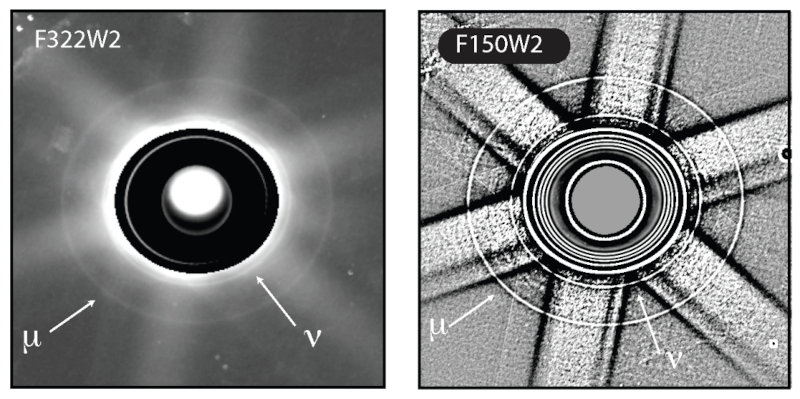
The rings also have different sources of material. The μ-ring is formed from particles ejected from the surface of the small moon Mab, approximately 12 km in diameter. This also means that Mab itself is mostly icy. The ν-ring is formed differently—from debris and dust produced by collisions of larger rocky bodies, which have not yet been directly observed.
Uranus’s moons are named after characters in William Shakespeare’s plays and Alexander Pope’s poems—a tradition established by John Herschel. Five large moons—Miranda, Oberon, Titania, Umbriel, and Ariel—orbit the outer reaches of the planet, while 14 smaller satellites orbit closer to the planet. It is within this inner group that the Mu and Nu rings are located, and it is there, according to a new study, that previously undiscovered moons may be hiding.


