
OpenAI Taught AI To Speak And Listen Simultaneously: GPT-Live-1 Via API Released
Credit: AI
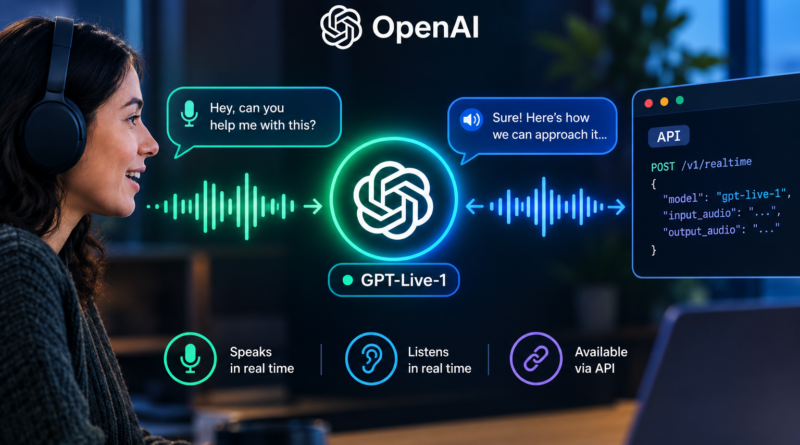
It released GPT-Live-1 via its API on Thursday, providing developers with a voice model for building voice-controlled applications and business processes. The model is capable of listening and speaking simultaneously, as well as delegating reasoning and execution tasks to other models and tools.
OpenAI’s GPT-Live-1 model was announced in July; it allows users to submit queries via voice rather than text. Initially available only through the ChatGPT interface, it can now be accessed via API. Full-duplex mode enables GPT-Live-1 to listen and generate speech simultaneously, making interaction feel more natural. In ordinary conversation, people often speak at the same time, and the need to strictly take turns—as required in half-duplex radio communication—can be frustrating.
GPT-Live-1 is designed to handle spoken dialogue, while a backend model—such as the flagship GPT-6 Astra or a more cost-effective model for simpler tasks—manages information retrieval, tool usage, and task coordination. This new model represents a step forward compared to the Realtime model released in 2024. In the Tau3 benchmark, which evaluates the intelligence of voice agents in customer service scenarios, GPT-Live-1 achieved a score of 86.2%, whereas GPT-Realtime-2.1 and GPT-Realtime-2 scored 45.7% and 42.4%, respectively. According to OpenAI’s own assessments, the new model demonstrates 30% higher efficiency on the Full Duplex Bench compared to GPT-Realtime-2.1, outperforming its predecessor in areas such as speaker-switch latency and the quality of interactive engagement. It has already been deployed in the Yelp Host service, making the table reservation process feel more natural.
The voice layer costs $0.05 per minute, billed by the second. That works out to $3 for an hour of continuous interaction.
However, $3 is not the total cost of the finished agent. The backend model, search capabilities, other tools, and infrastructure are billed separately. Therefore, it makes sense to use a low-cost model for tasks like scheduling and order status updates, while reserving the expensive model for tasks that genuinely require reasoning.


