
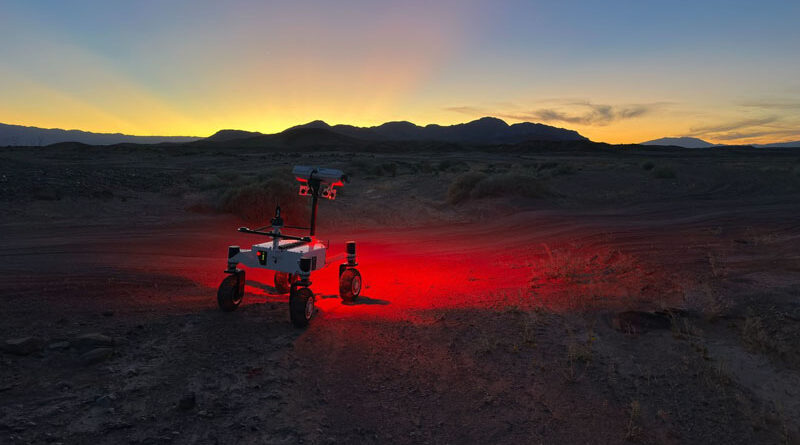
NASA Tested “Walking” Rover
Credit: NASA
NASA tested the experimental four-wheeled rover ERNEST (Exploration Rover for Navigating Extreme Sloped Terrain) in the Colorado desert. It could form the basis for future lunar and Mars rovers.
In March of this year, during a seven-day field test, ERNEST traveled approximately 26 km in 37 hours of travel with minimal engineering intervention, reaching speeds of up to 1 km/h in some sections—approximately an order of magnitude faster than the autonomous speed of NASA’s current Mars rovers, Curiosity and Perseverance. The increased speed and, consequently, increased range will improve the ability to explore planets without direct human intervention.
However, ERNEST’s unique feature isn’t so much its speed as its new chassis design. Unlike the classic passive suspension used on all NASA rovers since Sojourner, which distributed the load between six wheels using levers and hinges, ERNEST uses an active suspension.
Moreover, the suspension design allows the rover not only to redistribute weight between the wheels but also to select different motion modes: standard wheeled movement, snaking, and even climbing. The coupling mechanism allows the rover to switch back to a more energy-efficient passive suspension mode, while four individually controlled mesh wheels allow for not only forward and backward movement, but also sideways movement.
Engineers will now combine active suspension mode selection with long-range route planning. This will allow the rover to decide which obstacles can be overcome and which are best avoided.


