Hera Spacecraft Reveals First Images of NASA’s DART Asteroid Impact
Credit: ESA
Humanity’s first attempt to deliberately change the movement of an asteroid has entered a new chapter. The European Space Agency’s (ESA) Hera spacecraft has delivered its first detailed images of Dimorphos, the asteroid moonlet struck by NASA’s DART spacecraft in September 2022.
The images, unveiled on November 25, reveal a surprisingly dramatic aftermath. Scientists have discovered a massive impact crater, a heavily altered surface and hundreds of boulders surrounding the asteroid system.
A closer look at NASA’s historic asteroid impact
Dimorphos, measuring approximately 151 metres in diameter, became the target of NASA’s Double Asteroid Redirection Test (DART) mission four years ago. The spacecraft deliberately crashed into the asteroid at high speed to test whether a potentially dangerous space object could be pushed away from its original trajectory.
The experiment worked. The impact shortened Dimorphos’ orbital period around its larger companion, Didymos, by approximately 33 minutes.
However, scientists still needed to understand exactly how the collision changed the asteroid itself. This is where ESA’s Hera mission comes in.
After travelling through space for more than two years, Hera has reached the Didymos asteroid system and begun examining the consequences of the collision.
A stadium-sized crater and hundreds of floating rocks
One of the most striking discoveries is the scale of the damage caused by DART.
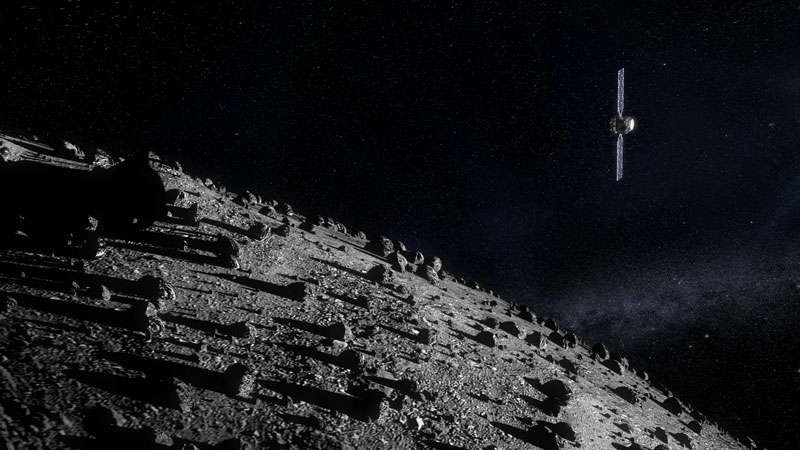
According to ESA researchers, the impact flattened one side of Dimorphos, creating a crater-like structure extending across much of the asteroid’s width. The findings suggest that the collision changed not only its surface but also its overall shape.
Another unexpected discovery is the presence of hundreds of boulders surrounding the binary asteroid system. Some of these objects are several metres across and appear to be moving in the extremely weak gravitational environment around the asteroids.
Researchers have also found evidence that Dimorphos is now rotating in a chaotic and unstable manner, adding another layer of complexity to understanding the long-term effects of the impact.
Why the Hera mission matters for Earth’s future
The importance of Hera goes far beyond photographing a damaged asteroid.
NASA’s DART mission demonstrated that a spacecraft could measurably change the orbit of a celestial body. Hera is designed to explain why the technique worked and how effectively it could be used in a real planetary defence scenario.
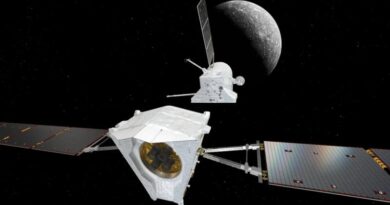
The spacecraft is equipped with several scientific instruments, including the Asteroid Framing Camera, the Hyperscout H multispectral imager and Japan’s Thermal Infrared Imager.
Together, these instruments will help scientists study the asteroids’ surface composition, temperature, structure and physical properties.
The mission will also deploy two small CubeSats, named Juventas and Milani, to investigate the asteroid system from even closer distances.
A new milestone in planetary defence
The first images from Hera provide an unprecedented look at the consequences of humanity’s first successful asteroid deflection experiment.
Scientists now have an opportunity to turn the results of DART into a more reliable scientific foundation for protecting Earth from potentially hazardous asteroids.
Although Dimorphos was never a threat to our planet, the experiment demonstrates that humanity may one day have a practical way to influence the trajectory of an approaching space object.
For now, Hera’s investigation is only beginning. Its next observations could reveal even more about how asteroids respond to powerful impacts — and how prepared we really are for a future threat from space.