Astronomers Detect Final Thermonuclear Flash in a Sun-Like Star for the First Time
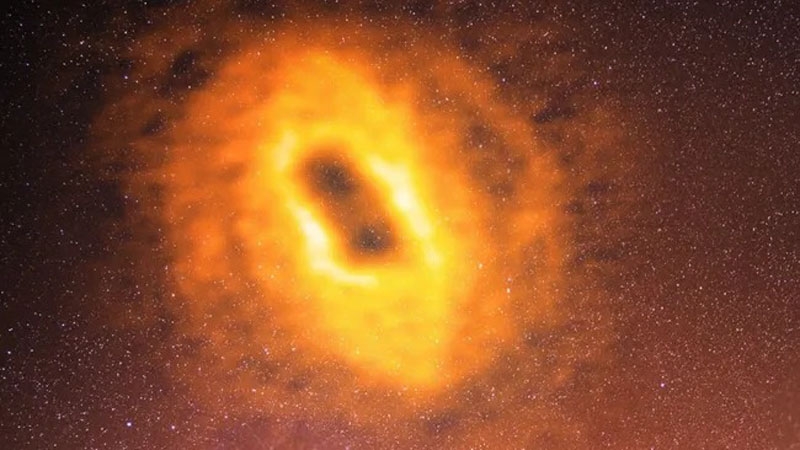
Credit: ALMA/ESO
Astronomers have captured what may be one of the most important moments in the final evolution of a Sun-like star: the aftermath of its last major thermonuclear pulse. Using the powerful Atacama Large Millimeter/submillimeter Array (ALMA) in Chile, researchers have identified a massive ring of gas surrounding a dying star, providing the first direct observational evidence of this rarely witnessed stellar event.
The star, known as IRAS 06530-0213, is located approximately 12,000 light-years from Earth in the constellation Monoceros. Its surrounding gas structures offer scientists an unprecedented opportunity to investigate how stars similar to our Sun lose their outer layers before eventually becoming white dwarfs.
ALMA reveals evidence of a star’s final nuclear pulse
The observations revealed an enormous ring of molecular gas measuring approximately half a light-year across. According to the research team, this structure was likely expelled around 6,500 years ago during the star’s final thermal pulse.
These brief episodes occur during the late stages of stellar evolution, when unstable nuclear burning inside a star triggers a sudden increase in energy production. The resulting changes can cause the star to eject significant amounts of material into surrounding space.
Although theoretical models have long predicted that such events should leave behind distinctive gas structures, obtaining direct observational evidence has been extremely difficult.
The ALMA observations now provide researchers with a rare physical record of this process.
A complex transformation before stellar death
The gas surrounding IRAS 06530-0213 also reveals an unexpected sequence of events.
Researchers estimate that mass loss from the star decreased significantly for approximately 2,000 years following the initial thermal pulse. It then increased again over the next 1,000 years, producing dense, irregular filaments around the central object.
Closer to the star, astronomers identified an emerging hourglass-shaped nebula, suggesting that the object has only recently entered the final stages of its transformation.
The structure may also indicate the influence of an unseen companion star. Its gravitational interaction could help explain the unusual distribution of gas, although further observations are needed to confirm this possibility.
Unexpected chemical signatures challenge existing models
Beyond revealing the star’s physical structure, the observations have uncovered another scientific puzzle.
The surrounding material contains unusual concentrations of certain heavy isotopes of carbon, oxygen and nitrogen. Their relative abundances do not fully match predictions from conventional models of stellar evolution and nuclear nucleosynthesis.
This suggests that the processes responsible for producing and distributing chemical elements inside aging stars may be more complicated than previously understood.
Scientists believe that additional observations will be necessary to determine whether unusual nuclear activity, stellar interactions or other mechanisms are responsible for these chemical signatures.
What does this discovery mean for the future of our Sun?
The discovery is particularly interesting because it offers a glimpse into the distant future of our own Solar System.
Like IRAS 06530-0213, the Sun is expected to expand into a red giant when it exhausts the hydrogen fuel in its core. During its later evolutionary stages, it will gradually lose its outer layers, creating a cloud of gas known as a planetary nebula. Its remaining core will eventually become a white dwarf.
This transformation will take place billions of years from now, but studying stars currently undergoing similar processes allows astronomers to test existing theories against real observations.
The findings, led by NASA Jet Propulsion Laboratory researcher Raghvendra Sahai, have been published in The Astrophysical Journal under the title The Last Gasps of a Dying Star: ALMA Observations of the Preplanetary Nebula IRAS 06530–0213.
By capturing the remnants of a star’s final thermonuclear pulse, astronomers have gained a rare new perspective on how Sun-like stars end their lives — and how their final moments help shape the material from which future stars and planetary systems may form.