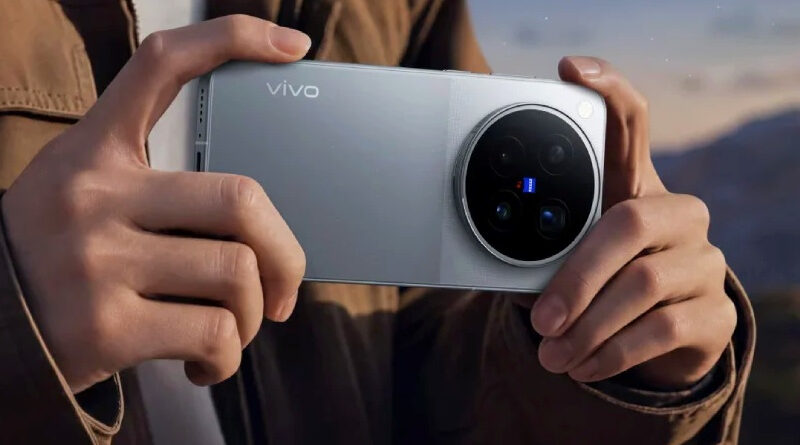
Vivo Unveils X500 Pro And X500 Pro Max Camera Flagships
Credit: Vivo
Vivo unveiled its flagship Vivo X500 smartphone series today. While the presentation took place in Shanghai, the international launch is scheduled for October—in a few weeks’ time. Specifically, the Vivo X500 Pro and Vivo X500 Pro Max models debuted, featuring Zeiss and Sony cameras.
Both smartphones are powered by the new MediaTek Dimensity 9600 Pro chipset. Vivo and MediaTek state that this is a joint development. The chipset houses over 33 billion transistors and utilizes a “2+3+3” CPU architecture (consisting entirely of high-performance cores) with 34.5 MB of cache memory. It is also the first mobile chip to support LPDDR6 memory and UFS 5.0 storage.
According to MediaTek, single-core performance has increased by 17% and multi-core performance by 15% compared to the previous generation, while peak power consumption during multi-core operation has dropped by 61%. The integrated neural processing unit enables the device to run MoE-type models with up to 30 billion parameters. Vivo leverages this capability to implement features such as one-touch automatic video highlight editing, available on both X500 Pro series models.
The Vivo X500 Pro smartphone features a 6.36-inch display made using Q11 luminescent material, developed in collaboration with BOE. It is an adaptive LTPO 8T panel with a 144Hz refresh rate, support for Dolby Vision and HDR10+, adaptive dimming capabilities, and a minimum brightness of 1 cd/m² (at the hardware level). The screen supports Circular Polarization 2.0 technology and holds SGS certification confirming low blue light emission for eye protection.
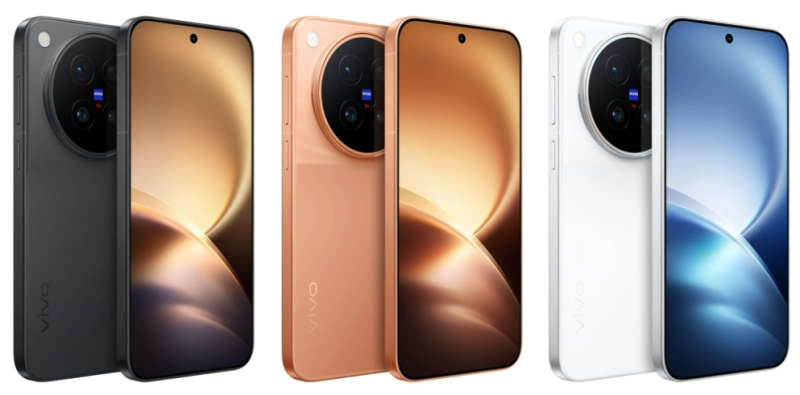
As always, the camera is a key highlight of the X-series smartphones. The main module is built around the new 50-megapixel BlueTouch 900 sensor. Vivo claims this is the first sensor of its kind to deliver a dynamic range of 17 stops, which is particularly important when shooting in challenging lighting conditions. The sensor works in tandem with a Zeiss Ultra-Dynamic lens and the updated Vivo VCS 4.0 system. It also incorporates a Zeiss anti-reflective coating and special glass designed for deep blue-spectrum absorption.
For the telephoto lens, Vivo combined its proprietary BluePrint optics with a 64-megapixel Sony LYTIA 610 sensor, tuning the system to the “golden” 85mm focal length. The company describes this as an industry-first solution. The ultra-wide-angle camera is equipped with a 50-megapixel Samsung JN5 sensor, while a 50-megapixel Samsung JN1 module handles selfies.
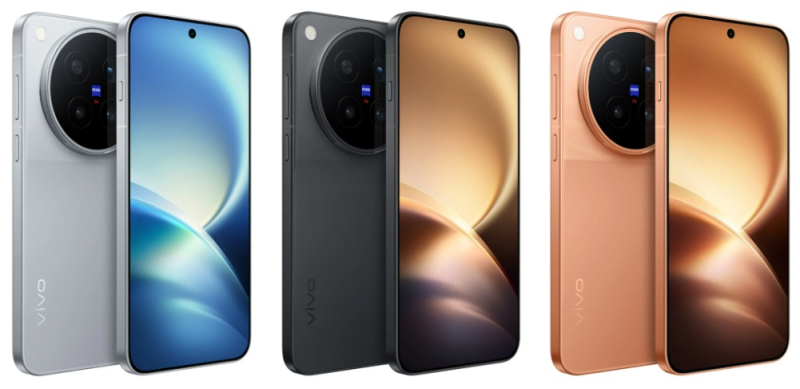
The Vivo X500 Pro Max features an enlarged 6.85-inch display. While still based on the Q11 panel, the screen now incorporates technology Vivo calls the world’s first “Q11 2K Zeiss Master Color Screen.” It utilizes a proprietary auto-brightness algorithm—developed by Vivo specifically for this panel—tuned to maintain consistent color reproduction as lighting conditions change.
However, the most significant differences lie in the rear camera setup. The X500 Pro Max is equipped with a 200-megapixel Zeiss APO super-telephoto camera featuring the 1/1.4-inch BluePrint x Samsung HP0 sensor. It supports lossless hardware-based 4x ISZ (In-Sensor Zoom). Vivo has placed special emphasis on keeping moving subjects in focus during high-magnification shooting. To achieve this, the device employs a suite of proprietary technologies: an optical telephoto tracking system, a high-speed capture system (60 fps), a high-refresh-rate Blueprint tracking mechanism, and the NICE algorithmic engine.
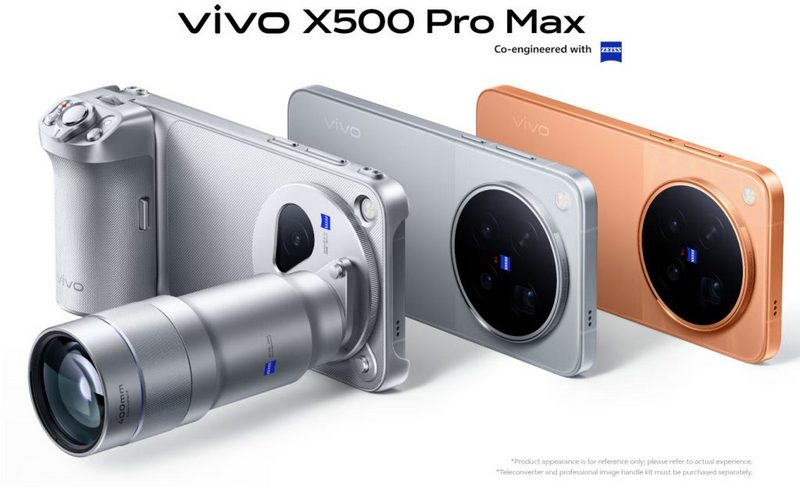
The Vivo X500 Pro Max is equipped with an 8,000 mAh battery, while the Vivo X500 Pro features a 6,510 mAh battery. Both smartphones support 90W wired charging and 40W wireless charging.
In China, the series will be available in four colors: white, gray, black, and orange. European versions will be unveiled later. Prices start at 6,500 yuan ($970) for the base model and 6,000 yuan ($1,045) for the higher-end model.