
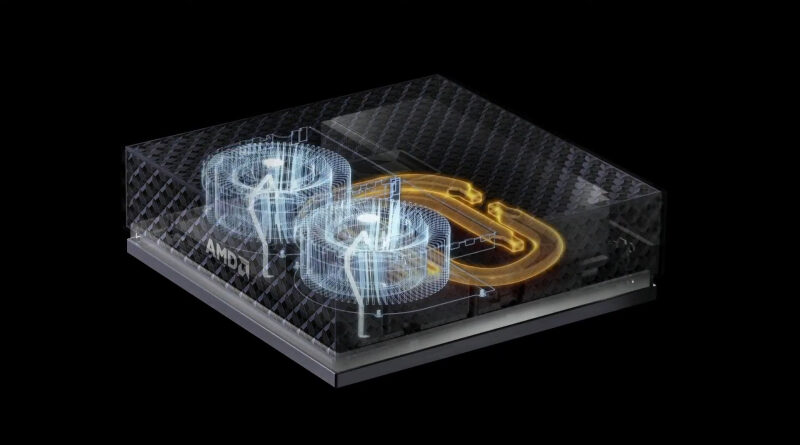
AMD Unveils AI Halo – Desktop Supercomputer
Credit: AMD
At CES 2026, AMD announced the AI Halo desktop supercomputer. This mini-PC-style system, powered by Strix Halo series processors (Ryzen AI MAX 300), is designed for running AI models locally. However, the new device can also be used for other tasks, including gaming.
Ryzen AI Halo is powered by the flagship Ryzen AI Max+ 395 APU. The platform supports up to 128 GB of LDDR5X-8000 memory, similar to DGX Spark, enabling the local execution of compact LLM and generative AI workloads. The Ryzen AI Max+ 395 chip delivers up to 126 TOPS of total performance: 50 TOPS from the XDNA 2 NPU, 60 TOPS from the Radeon 8060S GPU, and 16 TOPS from 16 Zen 5 CPU cores. Each component supports its own set of computation formats: INT8 and BF16 on the NPU, FP8/FP16/FP32 on the GPU, and INT8 and INT16 on the CPU (via AVX-512 and AVX-512 VNNI). It’s important to note that the Ryzen AI Max+ 395 chips support a configurable TDP from 45 to 120W, so given the TDP reduction to accommodate the AI Halo’s compact size, the actual performance of the AI PC may be lower than advertised. Furthermore, the complex, three-component architecture of the Ryzen AI Max+ 395 could also pose a barrier to achieving greater AI performance, as the simple APU assembly of the CPU and GPU portion of the Nvidia GB10 delivers significantly higher efficiency, reaching 1000 TOPS, and AMD hasn’t even come close to achieving these results. The very origins of the AI Halo also raise questions, as AI PCs based on the Ryzen AI Max+ 395 have previously been released by various AMD partners, such as Minisforum’s MS-S1 Max solutions, which offer similar specifications but are slightly larger.

AI Halo is scheduled to launch in the second quarter of this year. AMD has not yet released full system specifications.


