
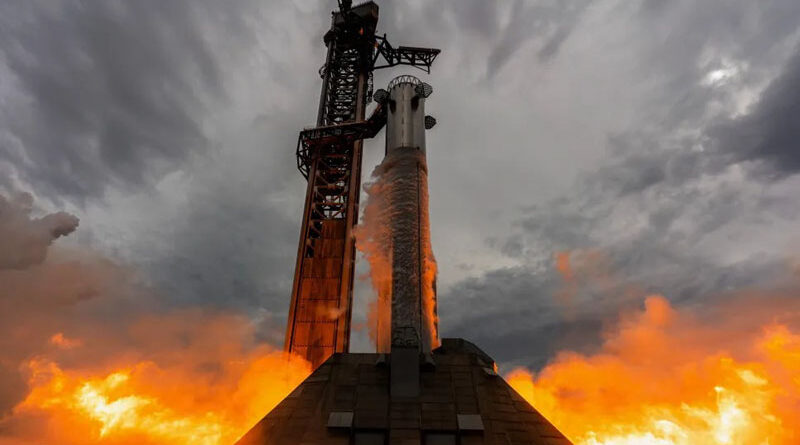
SpaceX Ignited All 33 Engines On Its New Super Heavy V3 Booster
Credit: SpaceX
SpaceX conducted a key test fire of its upgraded heavy-lift launch vehicle at a test site in Texas.
The Super Heavy V3 booster, a prototype version of Booster 20, was delivered to the launch pad on July 9 and installed on the test stand using the Mechazilla’s mechanical grippers. On July 10, the team simultaneously fired all 33 Raptor 3 engines for approximately 25 seconds—significantly longer than a typical short-term ignition test. The booster remained secured to the stand while specialists tested the combined operation of the engines, fuel system, automation, and ground infrastructure under sustained load.
Booster 20 became the second Starship V3 booster to complete a hot fire test on the launch pad. Its Raptor 3 engines use supercooled liquid methane and oxygen. Compared to the previous generation, the new booster modification features a redesigned propulsion system with a new firing algorithm, increased fuel tank capacity, and lightweight avionics. The Starship V3 upper stage also includes equipment for transferring cryogenic propellant between tanks—a key element of future orbital refueling. In a fully reusable configuration, the system is designed to deliver approximately 100 tons of cargo to low-Earth orbit.
The upcoming mission is designed to consolidate design changes following the partial failures of the May flight. At that time, the first stage failed to perform a braking maneuver, and an anomaly in one of the second stage’s engines was detected, prompting U.S. aviation regulators to initiate an official investigation. For the new flight, specialists plan to conduct a controlled descent of both stages followed by a soft splashdown in the Indian Ocean.


