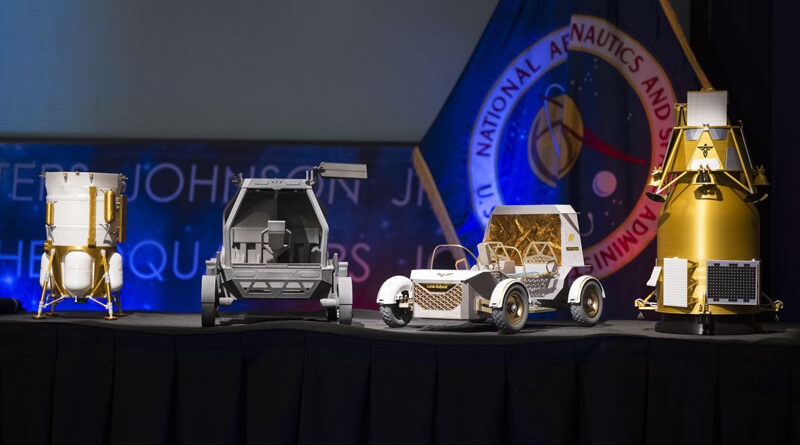
NASA’s Moon Base To Begin With Three Missions
Credit: NASA
On May 26, 2026, NASA announced the first stages of the project to establish a permanent human presence base on the Moon and signed a number of contracts for this purpose.
In short, the agency announced new contracts for lunar rovers, cargo landers, and reconnaissance missions, which are intended to pave the way for the Artemis IV astronauts to land on the moon’s surface and for a subsequent permanent human presence there. The agency emphasized that this is not a single expedition, but the consistent construction of humanity’s first extraterrestrial base.
The First Three Missions
The construction of the lunar base will proceed in several stages: first, robotic missions and technological experiments, then temporary infrastructure, and finally, a permanent human presence on the Moon. The first three missions are planned for 2026:
- Lunar Base I – launch no earlier than fall 2026 aboard Blue Origin’s Blue Moon Mark 1 Endurance lander. It will carry stereo cameras for studying engine-surface interactions and a laser retroreflector array for precise positioning of orbiters. The landing will take place in Shackleton Crater at the lunar south pole, to mitigate risks for the Artemis manned missions in 2028.
- Lunar Base II – launch in late 2026 aboard Astrobotic’s Griffin lander. It will deliver over 500 kg of cargo to the Moon, including Astrolab’s FLIP rover for testing mobile systems.
- Lunar Base III, the main research vehicle of Lunar Vertex, will be delivered to the Moon on Intuitive Machines’ Nova-C Trinity rover and will study lunar swirls, or bright spots on the Moon’s surface, to better understand surface evolution and the behavior of materials under extreme conditions. The mission will carry payloads from the European Space Agency (ESA) and the Korea Astronomy and Space Science Institute.
Each mission will aim to collect operational data and mitigate risks ahead of a human landing on the Moon.
The largest of the newly awarded contracts concerns the development of lunar rovers. NASA awarded $219 million to Astrolab and $220 million to Lunar Outpost. They will design and build wheeled vehicles for travel on the lunar surface, capable of transporting astronauts, cargo, and operating uncrewed. The Astrolab CLV-1 rover, based on the FLEX architecture, will weigh approximately 907 kg and be capable of reaching speeds of approximately 9.7 km/h (6.1 mph) on flat terrain. The Lunar Outpost Pegasus rover is designed to operate for up to one year, can be controlled manually, autonomously, or remotely, and can reach speeds of approximately 14.5 km/h (9.8 mph). Within the next 18 months, the companies are expected to complete the design, conduct crew evaluations, and prepare flight prototypes for operation.