
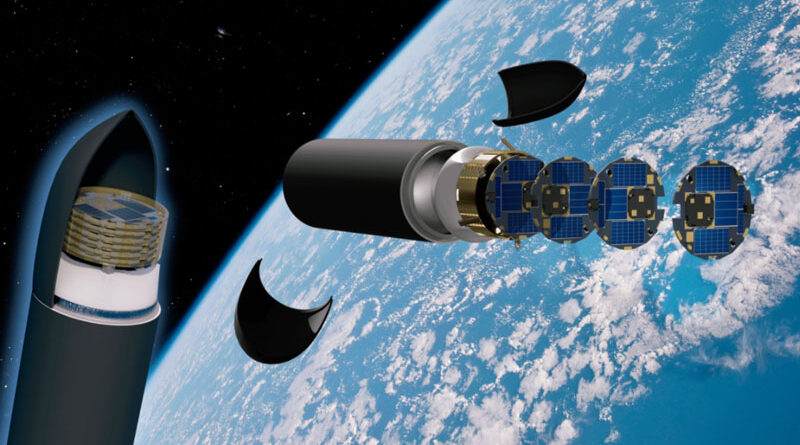
NASA And US Military Built Satellites In Shape Of Flying Saucers
Credit: Rocket Lab
The US Space Force is targeting ultra-low Earth orbit, where satellites cannot operate for more than a few weeks. For this purpose, small satellites in the form of flat disks or saucers with low drag have been developed.
A contract has been signed with Rocket Lab to launch the first batch of four Disksats. The STP-S30 mission, for the U.S. Space Force and NASA, will be flown on an Electron rocket and will cost U.S. taxpayers $14.4 million. The mission was originally planned for spring 2026, but it has been pushed back by several months and is hoped to launch on December 18, 2025.
The satellites are launched packaged in a distribution cassette and deployed individually into orbit at an altitude of approximately 550 km. The mission’s goal is to demonstrate stable operation in very low Earth orbit (VLEO, below 300 km), where strong atmospheric drag typically limits satellite lifespan to weeks or even days. The satellites will descend to VLEO autonomously, using their own propulsion systems.
Using electric propulsion systems, satellites can maneuver and maintain orbit. This opens up prospects for high-quality Earth imaging from lower altitudes, improved communications, and other defense and scientific applications.


