Scientists Created Diving Suits For Cyborg Cockroaches
Credit: Nanyang Technological University
Scientists from Nanyang Technological University in Singapore, together with colleagues from Japan, have developed a miniature “diving suit” for cyborg cockroaches, allowing these land-dwelling insects to safely survive underwater for up to three hours. Previously, the scientists demonstrated the ability to remotely control cockroaches on land using implanted electrodes. Now, they’ve taught them how to dive.
A team led by Hirotaka Sato demonstrated the ability to remotely control Madagascar hissing cockroaches (Gromphadorhina portentosa) using electrodes implanted in their sensory organs, the cerci. In 2024, the scientists demonstrated that a swarm of 20 of these cyborgs was capable of coordinating their actions. The initial goal was to create biological robots with infrared sensors to search for survivors after natural disasters. However, the insects’ inability to operate in flooded areas, often found in disaster zones, prompted the researchers to create a special suit.
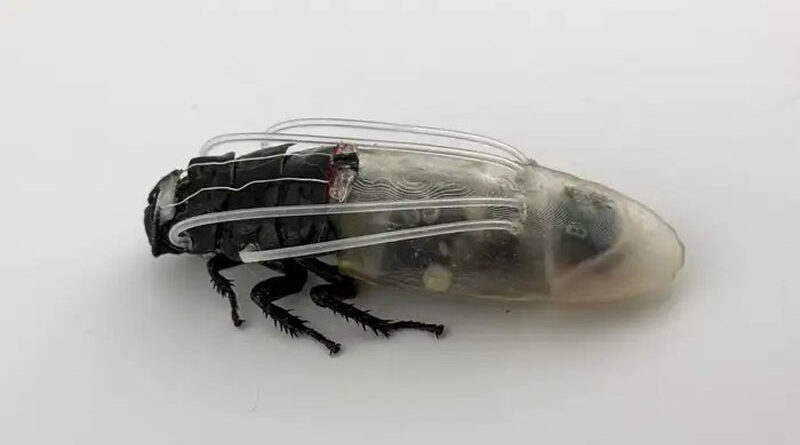
Cockroaches breathe through pores called spiracles, located on their abdomen and thorax. The scientists 3D-printed a waterproof suit made of resin that protects the abdominal spiracles from water. Miniature hoses connect the suit to the thoracic spiracles. Instead of an oxygen tank, the design included a mixture of hydrogen peroxide and manganese dioxide. When they react, hydrogen peroxide decomposes, releasing oxygen, which the insect consumes.
Wearing the suit, the cockroaches were able to walk underwater at depths of up to 50 cm, with an average walking speed of 87.5 mm/sec on land and only 78.4 mm/sec underwater. All five insects observed after the experiment remained healthy three days later.
Scientists also dream of creating spacesuits for insect scouts that can withstand the vacuum and cold of outer space. This will help conduct reconnaissance on Mars and other planets at a higher level. The next suit, the developers promise, will be for a cockroach-astronaut—they are already working on it.