
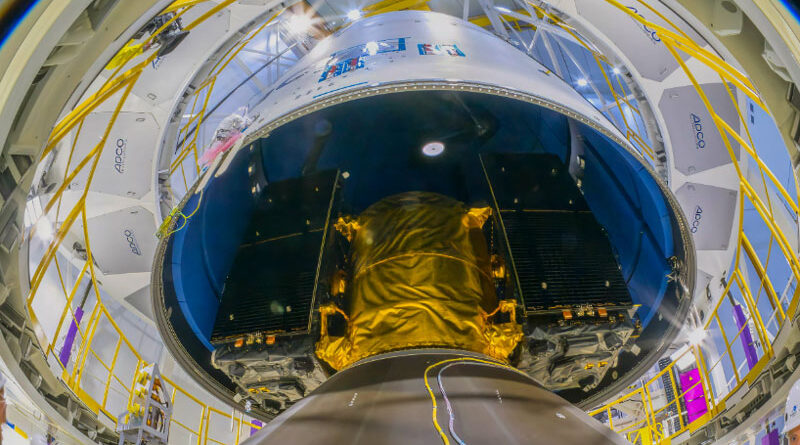
Ariane 6 Rocket Launched Galileo Satellites Into Orbit
Credit: ESA
The Ariane 6 launch vehicle successfully launched from the Kourou Spaceport in French Guiana, placing two European Galileo navigation satellites into orbit. The launch took place at 2:01 AM local time, and was broadcast live by Arianespace.
The satellites successfully separated after approximately four hours of flight, deployed their solar panels, and confirmed their normal status. The mission was declared a complete success.
The satellites were launched into medium Earth orbit at an altitude of approximately 23,222 km and, after three to four months of testing, will join the Galileo constellation, increasing the number of active satellites to 29. This will strengthen the system’s reliability and coverage. Two more similar launches are planned to complete the first-generation fleet, after which the integration of the second-generation satellites will begin.
Galileo, operational since 2016, is the most accurate global navigation system in the world: high-precision service (since 2023) provides horizontal accuracy of up to 20 cm and vertical accuracy (in altitude) of up to 40 cm. The system is used by more than 5 billion smartphones and is critical for transportation, agriculture, rescue operations, and financial services.
This flight marked the next step in the Ariane 6 flight test program. The rocket is available in Ariane 62 and Ariane 64 versions, with payload capacities of up to 5 and 10.5 tons, respectively.
The first launch of the Ariane 6 took place in July 2024.


